By Edwin Naidu
There is an urgent need to move from dependence to leadership, considering USAID funding cuts, says Professor Olusola Oyewole at UJ Higher Education Media roundtable in Johannesburg
In a powerful call to action, the Secretary-General of the Association of African Universities (AAU), Professor Olusola Oyewole, urged African institutions to reclaim ownership of the continent’s research agenda, financing, and leadership.
Speaking at a high-level seminar hosted by the University of Johannesburg (UJ) Library Services in collaboration with Higher Education Media Services (HEMS), Prof. Oyewole emphasised the urgent need for Africa to transition from dependence to leadership in the global research ecosystem.
“Africa cannot continue to outsource the financing, agenda, and leadership of its research,” Prof. Oyewole declared. “If this cycle continues, Africa will remain a research follower rather than a research leader.”
His views follow the findings of a powerful 98-page study, which found that the dismantling of the United States Agency for International Development (USAID) has resulted in an unprecedented crisis in global education and skills development, with far-reaching consequences for access, equity, and the quality of learning worldwide.
The report, commissioned by the European Training Foundation (ETF), looked at the implications of USAID’s funding withdrawal through four key lenses: funding trends and magnitude, geographic and programme impact, consequences for global education, and policy responses.
With more than $1 billion in annual allocations for international education, the U.S. is the largest bilateral donor in the sector, with most of its global aid funding managed by USAID.
The U.S. is also a major contributor to the Global Partnership for Education (GPE) and the Education Cannot Wait (ECW) multilateral initiatives.
According to the report, the abrupt cancellation of 396 education programmes funded by USAID in 58 countries will have immediate and long-term effects. In the short term, vulnerable groups – girls, refugees, and marginalised communities – will bear the brunt of disrupted services.
USAID’s dismantling jeopardises decades of progress in global education, says the study, with the most severe impacts felt in fragile and conflict-affected regions. The coming year represents a critical window for action. The European Union’s response (through increased funding, coordinated action, and strategic partnerships) will be vital to mitigating this crisis.
Without urgent intervention, the loss of USAID’s funding and leadership risks exacerbating inequalities, destabilising vulnerable regions, and leaving millions of children and youth without access to quality education.
Therefore, the AAU, as a technical partner of the Science Granting Councils Initiative (SGCI), under Prof Oyewole, believes that the cutbacks are just the push Africa – and the world – needs to “Break the Chains of Dependence: Towards African-Led, Globally Impactful Research”.
“Africa cannot continue to outsource the financing, the agenda, and the leadership of its research. We must rise—from dependence to leadership, from being knowledge consumers to becoming knowledge producers, and from being project implementers to being agenda setters,” he said.
Much of Africa’s research funding still comes from international donors, often tied to their priorities rather than the continent’s. “Our research infrastructure is fragile; our labs and centres are usually donor-built, donor-driven, and donor-dependent. African universities remain under-empowered to commercialise knowledge, influence policy, or retain talent,” Prof Oyewole said.
The seminar, attended by more than 50 participants in person and more than 60 online, explored African-led solutions to the funding crisis exacerbated by global economic shifts and recent cuts in international support, notably from the United States under former President Donald Trump. The discussion centred on building sustainable, locally rooted research ecosystems that are continentally coordinated and globally relevant.
Prof. Oyewole, who addressed delegates virtually via Microsoft Teams, outlined a bold four-pillar vision for African research transformation:
• African Financing of African Priorities: Establishing Centres of Excellence to drive continental missions.
• Industry and Government Co-Investment: Encouraging collaborative funding models.
• Talent Retention: Strengthening pipelines to keep Africa’s brightest minds on the continent.
• Agenda Setting: Empowering African universities to lead research initiatives rather than merely implementing externally driven projects.
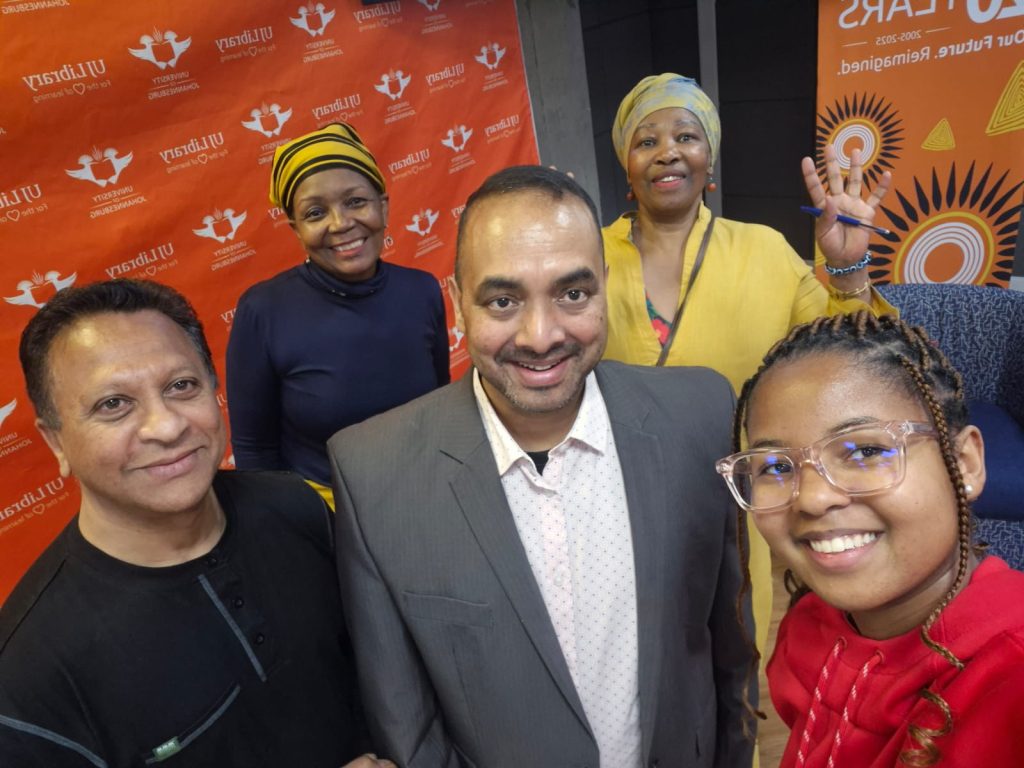
Moderated by Professor Ylva Rodny Gumede, Senior Director of Global Engagement at UJ, the seminar featured a distinguished panel of thought leaders. In-person guests included Professor Ramsaroop Sarita, Vice-Dean of Research and Innovation at UJ’s Faculty of Education; Glaudina Loots, Director of Health Innovation at the Department of Science, Technology and Innovation (DSTI); and HEMS editor Zingisa Mkhuma.
Joining virtually were Professor Thandi Mgwebi of the National Research Foundation (NRF), Professor Emilia Afonso Nhalevilo, Vice-Chancellor of Universidade Púnguè in Mozambique and President of SARIMA, and Prof. Oyewole from Ghana.
Prof. Mgwebi stressed the need for updated data on funding flows into Africa through initiatives such as the Science Granting Councils Initiative (SGCI). “We must build autonomy in our funding and encourage governments to reach the elusive one percent of GDP for research,” she said.
The NRF has launched a business advancement division and a digital transformation unit to diversify funding and strengthen science systems.
She called for a shift from extractive partnerships to equitable collaboration, knowledge sovereignty, and continental integration. “African researchers must publish knowledge in Africa for global contribution,” she added.
Prof. Nhalevilo echoed these sentiments, noting that African universities often mirror Western models, perpetuating dependency. She invoked Julius Nyerere’s philosophy of “education for self-reliance,” urging its revival in African schools and institutions.
DSTI’s Glaudina Loots highlighted the role of the Medical Research Council and SGCI in leveraging African scientific expertise, while acknowledging persistent challenges in health research funding.
UJ’s Prof. Ramsaroop emphasised mutual learning through equitable partnerships with the Global North, where African researchers take on principal investigator roles.
HEMS editor Zingisa Mkhuma advocated for leveraging Africa’s mineral wealth to fund education and research. “We must find our own way forward,” she said, cautioning against repeating cycles of dependency with new global powers.
Prof. Oyewole affirmed Africa’s capacity to lead: “Africa has the brains. Africa has the will. What we need is to move from dependency to leadership. The future will not wait for us. Let us fund our own research, set our own agendas, and lead globally through locally rooted solutions.” ©Higher Education Media
Edwin Naidu is a journalist and communications professional based in South Africa.